
Views: 0 Author: Site Editor Publish Time: 2026-10-22 Origin: Site


Manufacturing high-strength concrete structures, suspension bridges, or heavy-duty industrial springs presents a highly complex engineering challenge. These demanding applications require structural materials that will not warp, snap, or lose their critical tension under immense continuous pressure. Site engineers know this reality all too well. A snapped tendon during tensioning halts the entire project and poses severe safety risks.
During the initial cold drawing and forming stages, steel rods inevitably accumulate significant residual internal stresses. If left untreated, these trapped kinetic forces silently compromise the structural integrity of the material. Ultimately, this leads to premature fatigue failure or dimensional instability when subjected to heavy dynamic loads. The standard industrial solution to this metallurgical bottleneck is the stress-relieving process.
Executing this thermal treatment requires absolute precision. Finding the exact relief temperature is the definitive secret to unlocking the full mechanical potential of the metal without inadvertently altering its base structural properties. Whether you are specifying standard materials for a commercial build or sourcing specialized tendons for precast concrete applications, understanding these thermal parameters is strictly non-negotiable. This comprehensive technical guide explores ideal temperature ranges, processing environments, and the empirical reasons why sourcing certified materials protects your project timeline and bottom line.
Precision Matters: Empirical data indicates that the optimal stress-relieving temperature for most high-carbon steel wire typically falls between 350°C and 450°C. The exact parameter depends heavily on the specific steel grade, wire diameter, and intended structural application.
Preservation over Transformation: Unlike full heat treatment which fundamentally changes the microstructure of the steel through phase transformation, stress relieving solely eliminates residual mechanical stress while preserving original tensile strength.
The Low-Relaxation Advantage: Combining specific sub-critical temperatures with continuous mechanical tension produces low-relaxation strands. This is an essential component for the longevity of modern prestressed concrete.
Strict Compliance: Specifying certified materials guarantees strict compliance with rigorous international safety, testing, and performance standards.
To truly grasp why exact thermal calibration is vital, engineers must first examine the metallurgical changes occurring within the metal during manufacturing. Recognizing these microscopic shifts provides confidence in the reliability of the final product.
During the manufacturing phase, raw steel rods are pulled through a series of progressively smaller dies at room temperature. This aggressive mechanical action elongates the grains within the steel and drastically increases the dislocation density within the crystal lattice. While cold drawing successfully increases the tensile strength of the product—a phenomenon known as strain hardening—it simultaneously introduces severe internal mechanical stresses. Bending, cutting, and spooling further compound these trapped forces.
If these stresses are not neutralized, the material becomes highly susceptible to stress corrosion cracking and microscopic structural yielding over time. For instance, high-grade PC Wire designed for concrete reinforcement relies heavily on structural stability. Without proper thermal intervention, the wire will fail to maintain its required tensile strength, which often ranges from 1570 MPa to 1770 MPa depending on the specification.
Stress relieving operates within the recovery phase of metallurgy. By applying sub-critical heat—specifically, thermal energy remaining well below the transformation temperature of the steel at roughly 723°C—the atomic structure is allowed to safely relax. The trapped dislocations rearrange themselves into lower-energy configurations without initiating recrystallization or changing the fundamental phase of the alloy.
Getting this thermal calibration wrong has severe consequences. If the temperature is too low, dangerous residual stresses remain trapped inside the core. Conversely, if the temperature spikes too high, it initiates unwanted recrystallization. This accidentally softens the wire, drastically reducing its yield strength and ruining its load-bearing capacity. Such an error renders the batch completely unsafe for construction use.
In industrial procurement, buyers and site engineers sometimes use thermal processing terminology interchangeably. Mistaking full heat treatment for stress relieving can lead to catastrophic material specification errors and massive financial losses. The table below highlights the critical engineering distinctions between the two processes.
Process Feature | Full Heat Treatment | Stress Relieving |
|---|---|---|
Temperature Range | Exceeds upper critical limit, often above 800°C | Sub-critical range, typically 350°C to 450°C |
Microstructure | Fundamentally altered into martensite, pearlite, or bainite | Remains virtually identical to its pre-treated state |
Cooling Method | Rapid quenching or controlled slow annealing | Gradual air cooling to prevent new stress formation |
Primary Goal | Change hardness, ductility, and material behavior | Remove internal kinetic tension while preserving tensile strength |
There is no universal temperature for stress relieving. The exact thermal parameters must be meticulously calibrated based on the chemical composition of the alloy, the physical diameter, and the specific surface profile.
For standard high-carbon prestressed concrete applications, the optimal stress-relieving temperature generally ranges from 380°C to 420°C. Operating within this highly specific thermal window maximizes the ductility and elastic limit without sacrificing ultimate tensile strength. This delicate balance ensures the tendon can be safely tensioned on a busy construction site without suddenly snapping under the initial jacking load.
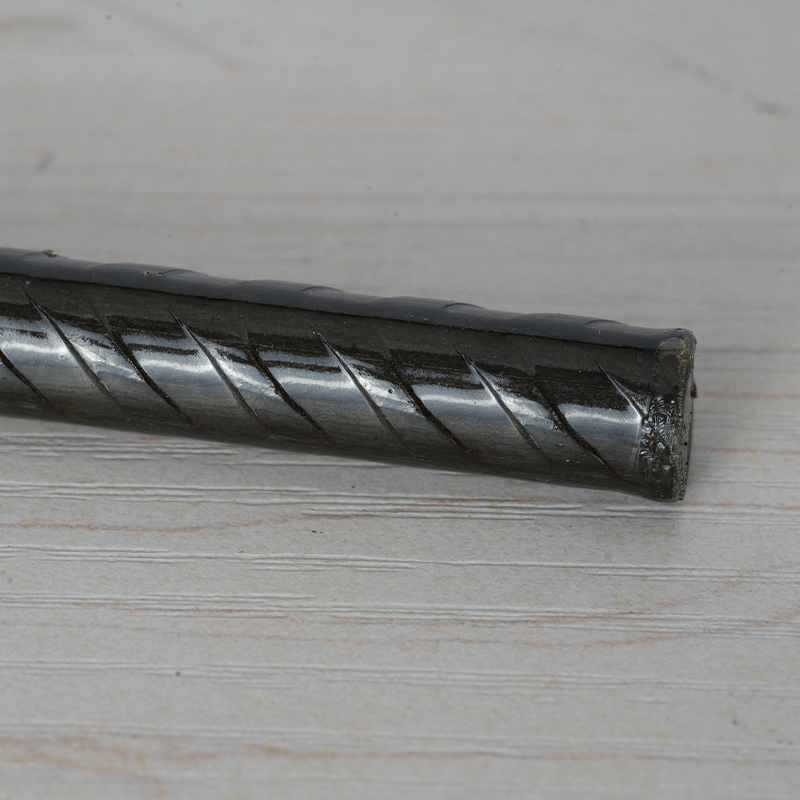
Surface modifications require highly specialized thermal handling. Engineered profiles like Indented Steel Wire feature geometric patterns designed to enhance mechanical interlocking with poured concrete. Because these physical indentations act as natural stress concentrators, the material is far more vulnerable to surface cracking if internal stresses are not perfectly resolved. This is especially true for common structural diameters like 5.0mm or 7.0mm. Manufacturers must employ highly uniform heating to ensure the core and the indented surface reach the target temperature simultaneously, thereby preventing dangerous micro-fissures.
Looking at current metallurgical trends, the global supply chain is experiencing a massive shift toward digitized thermal processing. As infrastructure standards for high-speed rail networks and nuclear containment vessels become increasingly stringent, top-tier manufacturers are abandoning manual furnace calibration. The industry is rapidly adopting AI-driven PID controllers and closed-loop induction heating systems. This technological leap allows for real-time micro-adjustments during the soak time, ensuring the relief temperature remains within a razor-thin margin of plus or minus two degrees Celsius. This level of automation virtually eliminates batch-to-batch mechanical variance.
While standard stress relieving is perfectly sufficient for mid-level applications, long-span infrastructure demands an advanced iteration of this thermal treatment known as the thermo-mechanical process.
In structural engineering, relaxation refers to the gradual and unavoidable loss of tension in a prestressing tendon over time, even when the physical length of the tendon remains securely anchored. In massive concrete structures, excessive relaxation causes the concrete to lose its vital compressive strength. This leads to sagging, severe cracking, and eventual structural failure.
To directly combat this phenomenon, advanced manufacturers utilize a sophisticated thermo-mechanical treatment. The metal is heated to a precise sub-critical range while simultaneously being subjected to a continuous calculated pulling force. This dual application of heat and mechanical stretching permanently aligns the molecular structure to resist future creep.
The resulting product of this complex engineering is a Certified Low-Relaxation Prestressing Steel Strand. Standard specifications demand a formidable tensile strength of 1860 MPa. Rigorous empirical testing demonstrates that these specialized strands exhibit a tension loss of less than 2.5 percent over 1,000 hours under constant load. This establishes them as the undisputed gold standard for suspension bridges, high-rise foundations, and heavy civil infrastructure.
In the high-stakes realm of structural engineering and heavy manufacturing, procuring cheaper uncertified materials is a dangerous false economy. The integrity of the thermal treatment process directly dictates the safety and lifespan of the final structure.
The catastrophic costs of tendon failure in prestressed concrete cannot be overstated. A sudden failure due to improper stress relief can lead to halted construction, millions of dollars in structural remediation, and severe legal liabilities. Uncertified products may contain unresolved internal stresses that easily pass basic visual inspections but fail catastrophically under continuous load.
To mitigate these risks, procurement teams must demand rigorous documentation. Sourcing Certified Stress-Relieved Steel Wire guarantees that the material was manufactured in strict compliance with global standards such as ASTM A421, EN 10138, and ISO 6934. Certified suppliers provide comprehensive Mill Test Certificates with every batch. These documents offer empirical proof that the batch was thermally treated at the exact required temperature, subjected to the correct soak time, and successfully passed independent quality assurance tests for yield strength and relaxation limits.
When evaluating a metallurgical partner, look for suppliers utilizing continuous induction heating lines or multi-zone batch furnaces equipped with advanced temperature controllers. Their engineering team should be capable of rapidly adjusting stress-relieving temperatures based on custom diameters, unique carbon compositions, and specific project load requirements.
Finding the correct relief temperature is a delicate, highly technical balancing act. If the temperature is set too low, harmful kinetic stresses remain trapped inside the metal. If set too high, the material loses its essential tensile strength. Ultimately, the exact precision of the thermal treatment dictates the success and safety of your infrastructure project. Whether your designs call for standard concrete reinforcement or specialized low-relaxation strands, partnering with a certified manufacturer ensures your materials will perform flawlessly under pressure. We encourage you to visit Tjdejia.com to explore our certified product lines, discuss your specific load requirements with our engineering team, and request a detailed technical quote.
The optimal temperature generally falls between 350°C and 450°C. However, the exact thermal parameter is highly dependent on the specific diameter, exact carbon content, the method of prior cold drawing, and the intended structural application. Precise calibration is required for every individual batch to ensure maximum performance.
No. When performed correctly at a highly controlled sub-critical temperature, stress relieving does not negatively impact the ultimate tensile strength. In fact, by eliminating internal mechanical flaws, the process significantly improves ductility, the proportional limit, and the overall elastic limit. This makes the wire much safer to tension on-site.
The required soak time varies significantly based on the mass, thickness, and thermal conductivity of the coil. In advanced continuous induction heating lines, the process can take just a few minutes as the metal passes through the coils. Conversely, in traditional high-capacity batch furnaces, it may take several hours to ensure uniform heat distribution from the outer layers to the core.
Certified low-relaxation strands undergo a specialized thermo-mechanical treatment involving simultaneous heat and tension. This permanently alters the behavior of the steel, drastically reducing tension loss over time. It typically limits relaxation to less than 2.5 percent over 1,000 hours. This superior long-lasting stability is absolutely essential for the safety of long-span concrete structures.
Proper stress relief is verified through rigorous mechanical testing rather than visual inspection. Engineers rely on tensile testing machines to measure the proportional limit and yield strength. A properly relieved wire will show a distinct improvement in ductility and a higher elastic limit compared to as-drawn wire. Additionally, reviewing the Mill Test Certificates provided by the manufacturer confirms the thermal parameters used during production.
The primary difference lies in the heating temperature and the resulting mechanical properties. Stress-relieved wire is heated to a sub-critical temperature to remove internal stresses while maintaining the high tensile strength achieved during cold drawing. Annealed wire is heated above the critical temperature and cooled slowly to completely soften the metal, making it highly pliable but significantly reducing its tensile strength. They serve entirely different structural purposes.


