
Views: 0 Author: Site Editor Publish Time: 2026-10-01 Origin: Site


Concrete inevitably fails when internal steel reinforcement slips under extreme stress. This remains a fundamental challenge in modern structural engineering. A helical rib steel strand solves this exact problem. It fundamentally alters force distribution within a concrete matrix. The result? Maximized bonding that keeps high-stakes structures safe.
In this engineering guide, we break down the exact mechanical principles of load transfer. We will look beyond basic specifications to help contractors, structural designers, and procurement managers make informed, data-driven purchasing decisions.
Mechanical Interlocking is Critical: The primary method a ribbed profile utilizes to transfer load is through physical interlocking. This grip prevents slippage significantly better than basic chemical adhesion.
Superior Stress Distribution: Engineered spiral grooves distribute applied stress evenly across the surrounding concrete. Localized micro-cracking drops drastically, heavily enhancing the structural lifespan.
Low Relaxation Matters: Pairing a ribbed design with premium metallurgical properties ensures initial tension is maintained for decades. This eliminates the risk of structural sagging.
Cost-Efficiency in the Field: Due to vastly enhanced load transfer capabilities, engineers can frequently optimize blueprints to use less steel and concrete per project.
A helical rib steel strand is an advanced tensioning material heavily utilized in prestressed and precast concrete applications. Physically, it consists of multiple high-carbon steel wires tightly twisted together to form a robust tendon. Unlike plain alternatives, the outer wires feature continuous spiral grooves along their entire surface area. This geometric alteration is not cosmetic. It is an engineered feature designed to aggressively engage the surrounding cement paste.
On the production floor, manufacturing these tendons demands strict metallurgical control. Before the individual high-carbon wires are twisted, they undergo a specialized cold-rolling process. Hardened industrial rollers press the specific helical pattern directly into the wire surface. This cold-working process must be perfectly calibrated. If the pressure is slightly off, the manufacturer risks compromising the core tensile strength of the steel. Following indentation, the wires are stranded together and subjected to intensive thermo-mechanical treatments to stabilize their mechanical properties.
The geometry of the helical ribs is rigorously calculated. Dimensions like the pitch, meaning the distance between spirals, along with depth and angle, are tailored to match the aggregate size of modern high-strength concrete mixes. If grooves are too shallow, the mechanical interlock will shear under heavy loads. Conversely, rolling them too deep creates dangerous stress concentrations within the steel wire itself. An optimal shape provides a balanced surface profile. This allows wet cement to flow seamlessly into the grooves during pouring and cure into a permanently locked matrix.
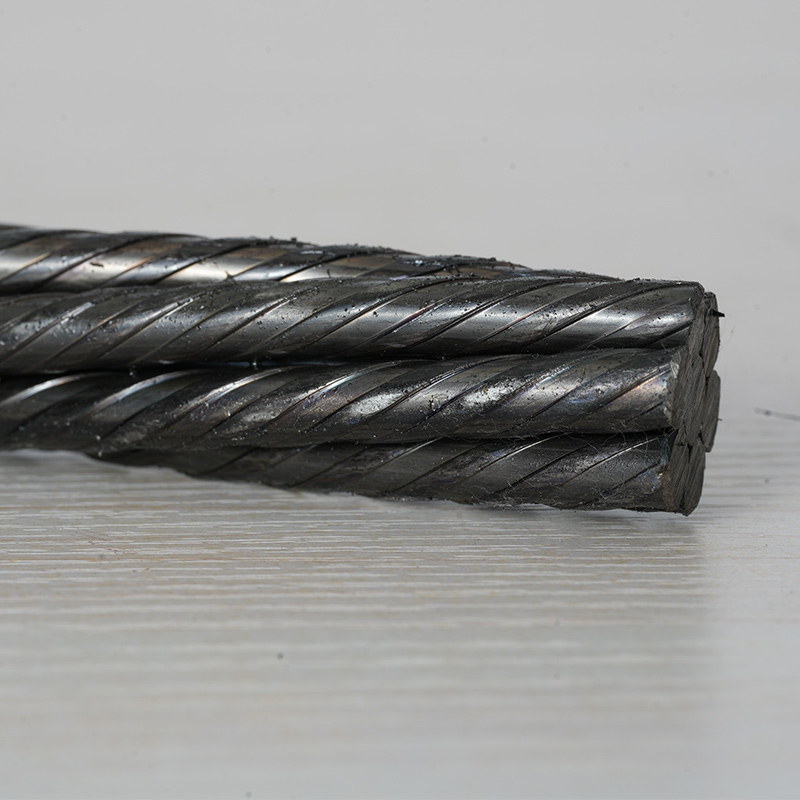
Understanding the exact mechanics of load transfer is non-negotiable for engineers evaluating tensioning materials. When a tendon is placed under extreme tension and concrete cures around it, releasing that tension transfers the load from the steel directly into the concrete. For a ribbed profile, this transfer occurs in three progressive phases.
Initially, load transfers via microscopic chemical adhesion. As concrete cures, hydration products form a fragile chemical bond with the steel surface. This acts as the first line of defense against slippage. However, chemical adhesion is highly brittle. Under dynamic loading, such as a freight train crossing a precast bridge, this microscopic bond fractures almost instantly. Once adhesion fails, the load transfer mechanism must rapidly shift.
After the initial bond breaks, frictional resistance takes over. As concrete shrinks during curing, it exerts massive radial compressive force around the tendon. When tension on the steel is released, the strand naturally attempts to expand laterally. This violent expansion increases radial pressure against the surrounding concrete. While friction plays a major role for smooth wires, it depends entirely on the confining pressure of the concrete. Environmental degradation or freeze-thaw cycles can easily compromise this pressure over time.
The ultimate and most reliable load-transfer mechanism is mechanical interlocking. This phase is uniquely optimized by the ribbed design. As the tendon experiences extreme longitudinal tension and attempts to slip, the concrete cured inside the spiral grooves acts as a physical wedge. The ribs function like a series of thousands of microscopic anchors. Instead of relying merely on surface friction, pulling forces are transferred directly into compressive and shear forces within the surrounding concrete matrix. To pull this strand out, the concrete itself must physically shear. This provides a vastly superior safety margin.
Global infrastructure is rapidly aging. Consequently, structural engineers are rethinking load-transfer mechanics to prioritize longevity. Recent civil engineering analyses show a massive pivot away from conventional smooth wires. This shift is particularly evident in high-seismic zones and heavy-duty infrastructure projects. The industry consensus is clear. Materials offering superior mechanical interlocking are no longer optional; they are mandatory to mitigate catastrophic failures. Modern design codes increasingly prioritize lifecycle durability over initial material costs, making engineered ribbed profiles the undisputed benchmark.
In the field, pull-out failure is catastrophic. It occurs when applied tensile load exceeds the bond strength between steel and concrete, causing the tendon to violently slip. Continuous spiral indentations drastically increase the total surface area in contact with the concrete. This creates a formidable physical barrier against wire pull-out. In dynamic load situations, such as seismic events or extreme wind loads battering high-rise core walls, mechanical interlock maintains structural integrity long after conventional materials fail.
In prestressed concrete beams, the violent transfer of force often causes concentrated stress points at anchorage zones. When plain wires are used, load transfer relies heavily on the sudden expansion of the steel. This causes bursting stresses and subsequent micro-cracking in concrete end-blocks. Ribbed profiles mitigate this issue by distributing stress evenly along the entire length of the tendon. Because grooves engage the concrete continuously, peak stress drops. This drastically lowers the risk of concrete fracturing.
Steel relaxation refers to the gradual loss of tension when a tendon is held at a constant length. When a wire is stretched during prestressing, its internal metallurgical structure slowly yields over the years. The pulling force drops. If this relaxation rate is too high, the concrete structure loses its designed compressive force. This inevitably leads to sagging, severe cracking, and eventual collapse.
To maximize project safety, procurement teams must specify the exact right materials. Combining a ribbed geometric design with a Certified Low-Relaxation Prestressing Steel Strand creates the ultimate structural synergy. Advanced metallurgical properties, such as a high tensile strength of 1860 MPa, ensure the steel maintains its critical pulling force over a century-long lifespan. Standard parameters guarantee a stress loss of no more than 2.5 percent after 1,000 hours of testing. Simultaneously, helical grooves ensure this sustained force is continuously transferred to the concrete without a millimeter of slippage.
For procurement managers making purchasing decisions, understanding the empirical differences between traditional materials and engineered ribbed profiles is essential to managing project risk.
Smooth tendons have been the industry standard for decades. They consist of plain, un-indented high-carbon wires. While widely available and cheaper to manufacture, their performance limitations are significant. A standard prestressing steel strand with a smooth profile relies almost entirely on chemical adhesion and friction. Consequently, they carry a much higher risk of slippage under dynamic loads and require significantly longer transfer lengths in precast concrete.
Ribbed tendons represent a highly engineered upgrade. Empirical testing consistently demonstrates that these profiles provide up to 40 percent better bond strength with concrete compared to smooth counterparts. They allow for shorter transfer lengths, enabling the production of smaller, lighter precast elements without sacrificing strength. While the specialized manufacturing process results in a slightly higher upfront material cost, engineers frequently offset this expense by reducing the overall volume of concrete and supplementary rebar required.
Technical Feature | Smooth Prestressing Strand | Helical Rib Steel Strand |
|---|---|---|
Primary Load Transfer | Friction & Chemical Adhesion | Mechanical Interlocking |
Concrete Bond Strength | Standard industry baseline | Up to 40% Higher |
Transfer Length | Longer embedment required | Shorter and highly efficient |
Micro-Cracking Risk | Moderate to High | Low due to even stress distribution |
Ideal Application | Standard Post-Tensioning | High-Stress Precast, Heavy Infrastructure |
Advanced load-transfer mechanics make this specialized material the preferred choice for demanding engineering environments.
In the precast concrete industry, manufacturing speed and material efficiency dictate profitability. Ribbed tendons are extensively utilized in producing railway sleepers, hollow-core floor slabs, and precast bridge girders. Because the physical grip shortens the required transfer length, precast manufacturers can design elements with maximum prestressing force closer to the very ends of the beam.
For mega-projects, structural failure is simply not an option. A high-strength construction steel strand featuring a ribbed profile is frequently specified for highway overpasses, long-span suspension bridges, and liquid natural gas storage tanks. In high-rise commercial buildings subject to dynamic wind loads, mechanical interlocking ensures the concrete core remains under constant compression.
Beyond above-ground architecture, these materials are highly effective in subterranean applications. They are routinely deployed in ground anchors, soil nailing, and deep rock bolts. Inserted into drilled shafts and grouted in place, spiral grooves maximize the bond between the steel and surrounding cementitious grout. This provides unmatched pull-out resistance against unstable soil formations.
Selecting appropriate tensioning materials is a critical risk-management exercise. General contractors must look far beyond basic pricing and rigorously evaluate metallurgical properties.
The global steel market is saturated with varying grades. The foundational requirement is strict adherence to international metallurgical standards. Procurement teams must verify compliance with globally recognized specifications like ASTM A416/A416M, EN 10138-3, or ISO 6934-4. Always request Mill Test Certificates to verify chemical composition, specifically carbon, manganese, and silicon content.
Not all ribbed profiles are manufactured equally. The exact dimensions of the helical grooves must match your specific concrete mix design. Buyers must verify the pitch, which dictates the interlocking area. Verify the rib depth, which determines how effectively concrete wedges into the strand without compromising cross-sectional area. Using an incompatible geometry for your specific aggregate size results in suboptimal load transfer.
Sourcing reliable materials requires evaluating internal testing protocols. The production line should utilize continuous Non-Destructive Testing, such as eddy current inspections, to detect microscopic surface flaws. Furthermore, suppliers must maintain ISO-certified laboratories capable of performing destructive testing and 1,000-hour relaxation tests. Ensure every delivered coil is tagged with a unique identification number linking it to its specific heat batch.
A helical rib steel strand transfers load primarily through powerful mechanical interlocking. This makes it vastly superior to smooth alternatives in preventing slippage and stress concentration. By forcing concrete to wedge into continuous spiral grooves, high-stress structures remain highly durable under severe dynamic loading.
Investing in high-quality, low-relaxation ribbed materials is a direct investment in project safety and longevity. When structural integrity is on the line, selecting the right tensioning profile makes all the difference. Explore premium, certified tensioning materials at TJ Dejia to ensure your next large-scale infrastructure project meets the highest global standards.
The fundamental difference lies in surface geometry and load-transfer mechanics. A standard smooth wire relies primarily on microscopic chemical adhesion and friction generated by concrete shrinking around the steel. Under extreme tension, this bond can fracture. Conversely, a helical profile features continuous spiral grooves. When concrete cures, the aggregate physically wedges into these grooves. This creates a powerful mechanical interlock that forces the concrete to resist pull-out through compressive and shear strength.
Transfer length is the distance required to transfer the full effective prestressing force from the steel to the surrounding concrete. When a tensioned strand is released, it expands slightly in diameter. Plain wires rely solely on this lateral expansion for grip. Helical ribs amplify the process. The physical barriers created by grooves immediately engage the surrounding concrete matrix, locking the steel in place much faster and transferring longitudinal forces over a significantly shorter distance.
Steel relaxation is a metallurgical phenomenon where a tendon gradually loses pulling force over time. A certified low-relaxation strand undergoes a specialized stabilization process involving simultaneous high mechanical tension and elevated temperatures around 380 degrees Celsius. This realigns the steel microstructure, ensuring it loses less than 2.5 to 3.5 percent of its initial tension over a 1,000-hour test period.
Yes, they are highly effective in bonded post-tensioning applications. In these systems, steel tendons are routed through corrugated ducts within concrete formwork. After tensioning, high-strength grout is pumped into the ducts. Spiral grooves provide an exceptional surface profile for the injected grout to grip. This mechanical interlock ensures tension force is maintained by the continuous bond along the duct, even if mechanical end-anchors fail.
Indentation depth is a carefully engineered parameter balancing bond strength with material integrity. If grooves are too shallow, concrete paste cannot sufficiently penetrate them. If they are rolled too deeply, it reduces the effective cross-sectional area of the steel. Deep grooves act as stress concentrators, potentially initiating fatigue cracks or reducing the ultimate breaking load of the wire.
Proper storage is critical because high-carbon steel is highly susceptible to corrosion. Minor surface pitting significantly reduces fatigue resistance. Materials must be stored in a dry, well-ventilated environment, elevated on wooden dunnage or steel racks to prevent soil moisture absorption. If stored outdoors, coils must be securely covered with heavy-duty, waterproof tarpaulins with adequate airflow.
In most cases, yes, but verification with the anchor manufacturer is required. Post-tensioning systems utilize conical steel wedges with internal serrated teeth to grip the tendon. Because helical ribs alter the outer diameter, wedges must be capable of biting through the geometry to engage the solid steel core beneath. Standard wedges are typically hardened enough to grip them effectively.
Relaxation testing is a rigorous laboratory process. A sample is placed in an instrumented testing frame within a climate-controlled room at 20 degrees Celsius. It is tensioned to 70 or 80 percent of its actual breaking load and locked at a constant length. Load cells continuously monitor the tension decrease over 1,000 hours. Metallurgists use logarithmic extrapolation models based on this data to guarantee maximum stress loss over a 50-year service life.
Generally, standard hydraulic stressing jacks handle ribbed strands without issue. However, because the outer profile is textured, the gripping jaws inside the jack may experience slightly higher wear over thousands of cycles compared to pulling smooth wires. Site engineers should ensure the jack's internal gripping mechanisms are regularly inspected and cleaned of any steel debris generated during the tensioning process.
The pitch varies based on the strand diameter and specific international standards like ASTM A416 or EN 10138. Typically, the lay length or pitch is engineered to be 12 to 16 times the nominal diameter of the strand. This specific ratio ensures the spiral angle is steep enough to provide maximum interlocking area for the concrete aggregate, without creating sharp angles that could induce shear stress on the steel wires during tensioning.


