
Views: 0 Author: Site Editor Publish Time: 2026-09-22 Origin: Site


When manufacturing high-strength steel for heavy construction, the cold-drawing process naturally introduces a massive amount of internal tension. To make the material usable without snapping under immense pressure, it must undergo a meticulously calibrated heat treatment known as stress relieving. However, a common question consistently arises among structural engineers, metallurgists, and procurement specialists: where exactly does this treated wire keep its residual stress?
There is a widespread misconception across the construction industry that thermal treatment removes all internal stress from the material. If that were true, the steel would undergo complete recrystallization. It would become soft, completely stripping away the high tensile strength required for demanding applications like prestressed concrete infrastructure. Instead, the process carefully manages, aligns, and redistributes this tension. By sourcing high-quality Certified Stress-Relieved Steel Wire, engineering teams ensure they are working with a material that strikes the perfect metallurgical balance between raw power and necessary flexibility.
Understanding this balance is essential for modern builders. Let's explore the microscopic science behind residual tension, how the precise heat-treatment process works, and why rigorous quality control is the absolute bedrock of structural longevity.
Stress is Stored Microscopically: Residual stress in treated steel is never entirely eliminated. Rather, it is securely stored at the atomic level within the crystal lattice and grain boundaries.
Balance is Key: Retaining a specific, calculated amount of micro-stress gives the wire its essential high yield strength while simultaneously improving ductility for on-site handling.
Relaxation Prevention: Proper thermal management minimizes dangerous macro-stresses. This is the foundational science behind manufacturing low-relaxation materials for long-span structures.
Surface Variations Matter: Procurement teams can choose between smooth profiles or modified surfaces to improve concrete bonding. Both rely on identical internal stress management.
Certification is Non-Negotiable: Utilizing verified materials ensures that remaining internal stresses meet strict safety standards, actively mitigating the risk of catastrophic failure.
To fully grasp where residual stress ultimately resides, we must first examine how it gets there. The creation of high-strength reinforcement relies heavily on aggressive mechanical manipulation long before any heat treatment occurs.
The production cycle begins with standard high-carbon steel rods. At room temperature, these raw rods are systematically pulled—or "drawn"—through a series of progressively smaller tungsten carbide dies. Because this intense mechanical compression happens well below the steel's recrystallization temperature, the metal undergoes severe plastic deformation.
As the wire's diameter shrinks, its naturally spherical internal grains are forcibly elongated into tight, fibrous structures. This action forces atomic layers to slide over one another, multiplying structural dislocations and dramatically spiking the material's tensile strength. However, this massive mechanical force does not simply vanish. The steel absorbs it as immense internal tension, commonly referred to as macro-stress.
Furthermore, leaving the wire in this raw state makes it structurally unacceptable. Picture a site crew trying to tension a 100-foot span of heavily cold-drawn, untreated wire on a freezing morning. Because 100% of the manufacturing macro-stress remains unevenly trapped across the cross-section, the material is a ticking time bomb. It lacks the ductility to withstand the bite of anchoring jaws. It becomes highly susceptible to violent, sudden snapping when subjected to external dynamic loads. This creates the absolute necessity for thermal intervention.
This brings us to the core metallurgical puzzle. When the wire is heated to relieve dangerous tension, where does the remaining stress hide to maintain the steel's strength? The answer lies deep within the atomic architecture of the metal.
To understand this, one must differentiate between macro-stress and micro-stress. Macro-stresses are large-scale, unbalanced tensions that span across the entire physical geometry of the wire. These are the destructive forces responsible for warping and brittleness. Stress-relieving treatments are engineered specifically to neutralize these large forces.
In contrast, the process intentionally leaves behind micro-stresses. These are highly localized tensions that exist over minuscule distances, usually spanning only a few atomic grains. The residual stress is securely locked at this microscopic level—specifically within the structural dislocations of the crystal lattice and along the elongated grain boundaries.
During cold drawing, millions of microscopic defects are created in the atomic grid. When the steel is subsequently heated, the thermal energy grants the iron and carbon atoms just enough mobility to shift and resolve the large-scale macro-stress. Yet, this energy is deliberately kept low enough so that the microscopic dislocations remain intact. Think of these remaining tension points as billions of tightly coiled, nano-scale springs locked within the metal. This stored potential energy provides the wire with its incredible load-bearing capacity.
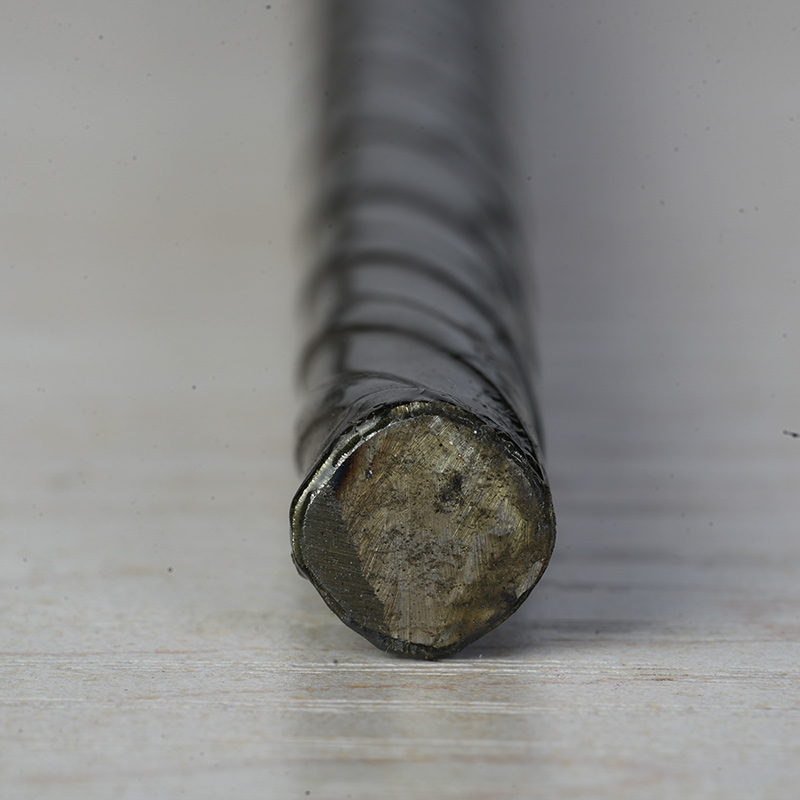
Managing this delicate atomic balance requires highly controlled factory environments. The stress-relieving process is far more complex than simply throwing metal into an oven; it is a meticulously calibrated thermo-mechanical operation.
The standard procedure involves passing the cold-drawn wire through a continuous inline induction furnace. The heating parameters are strictly maintained in a sub-critical range, typically between 350°C and 400°C (660°F to 750°F). This specific temperature window is vital. It provides sufficient thermal energy to excite the atoms, allowing them to realign and shed the dangerous macro-tension without causing the crystal lattice to recrystallize. The fundamental pearlitic microstructure of the high-carbon steel is perfectly preserved.
Specifically, heat alone is rarely enough to produce premium-grade reinforcement. As the wire travels through the furnace, a strictly calibrated mechanical pull is applied. This tension physically aligns the remaining microscopic residual stresses parallel to the longitudinal axis of the wire. By forcing the crystal lattice to settle into a linear, load-optimized state while cooling, manufacturers ensure the material will perform predictably when stretched by hydraulic jacks on a job site.
The precise management of microscopic tension directly influences one of the most critical performance metrics in structural engineering: steel relaxation.
In civil engineering, relaxation refers to the gradual, time-dependent loss of tension in a wire that is stretched and anchored at a constant length. When reinforcement is installed in prestressed concrete, it is pulled incredibly tight. Over decades, if the internal residual stresses are unstable, the atomic structure will slowly shift to relieve the strain. The wire goes slightly slack. This loss of compressive grip leads to severe concrete cracking and a reduced structural lifespan.
By effectively managing residual stress at the factory level, manufacturers virtually eliminate this risk. Heating the wire while it is under tension artificially accelerates the steel's natural relaxation phase in the controlled environment of the furnace. It exhausts its tendency to slacken before it ever reaches the job site. This is exactly why structural engineers mandate the use of a Certified Low-Relaxation Prestressing Steel Strand for high-stakes infrastructure.
While the underlying principle of microscopic stress storage remains consistent, the exterior profile of the wire must be matched to specific load transfers and concrete bonding requirements. Below is a practical selection matrix based on standard industry parameters.
Product Type | Typical Diameter | Tensile Strength | Surface Profile | Best Application Scenarios |
|---|---|---|---|---|
Standard PC Wire | 4.0mm - 9.0mm | 1570 - 1770 MPa | Smooth | Railway sleepers, utility poles, large-diameter concrete pipes. Relies on end-anchors. |
4.0mm - 9.0mm | 1570 - 1770 MPa | Chevron/Dot Grooves | Precast panels requiring rapid load transfer without heavy reliance on mechanical end-anchors. | |
4.0mm - 9.0mm | 1570 - 1770 MPa | Raised Spiral Ribs | Seismic-resistant structures requiring maximum pull-out resistance and screw-like concrete bonding. | |
Low-Relaxation Strand | 9.53mm - 15.24mm | 1860 MPa | 7-Wire Twisted | Long-span bridges, heavy-duty commercial high-rises, post-tensioned slabs. |
Crucially, whether you choose a smooth profile or an indented one, the internal core of the wire undergoes the exact same stress-relieving process. Enhanced surface grip does not compromise internal tensile strength.
Looking at recent developments in global structural engineering, there is a clear shift toward Ultra-High-Performance Concrete (UHPC) and increasingly longer bridge spans. As urbanization accelerates, architectural designs are pushing the boundaries of load-bearing capabilities while attempting to minimize overall material weight.
This trend places unprecedented demands on prestressing materials. UHPC allows for thinner concrete profiles, which means the steel reinforcement must carry a higher proportional load. Consequently, the margin for error in residual stress management shrinks to near zero. Modern engineers are no longer satisfied with standard steel; they specify materials with strictly managed, highly predictable stress profiles. In today's mega-structures, even a 2% higher relaxation rate over a decade can lead to millions of dollars in structural maintenance. This drives top-tier manufacturers to adopt increasingly stringent thermo-mechanical quality controls.
Understanding the complex metallurgy behind micro-stress retention highlights a critical reality for procurement specialists: you cannot verify the internal atomic structure of a steel wire simply by looking at it. Rigorous certification is your only insurance policy.
When a product is certified, it indicates that the specific batch has undergone standardized, independent laboratory testing. Testing protocols empirically verify the ultimate tensile strength, the exact yield point, elongation limits, and the long-term relaxation percentage. Reputable manufacturers produce wire that complies with strict global frameworks such as ASTM A421, EN 10138, or BS 5896. These designations guarantee that the stress-management protocols were executed flawlessly.
The risks associated with procuring uncertified, cut-rate wire are immense. If the heat treatment was skipped or rushed, the wire retains dangerous levels of macro-stress. Uncertified wire may snap suddenly during the tensioning process, endangering lives on the job site. Investing in certified materials is fundamentally an investment in liability prevention.
Stress-relieved steel wire does not lose its internal tension entirely; rather, it masters it. By safely locking residual stress away at the microscopic level within the crystal lattice and grain boundaries, manufacturers create a product that is simultaneously incredibly strong and safely workable. Whether you are engineering a highway overpass or specialized precast elements, understanding this atomic-level balance highlights exactly why you must invest in high-quality materials. To guarantee the safety, durability, and ultimate success of your concrete projects, always ensure you are partnering with a technically proficient supplier.
Ready to secure the structural integrity of your next project? Evaluate your load requirements and source verified, industry-compliant materials directly from experts. Visit Tianjin Dejia today to explore a full range of certified prestressing steel products tailored for demanding engineering applications.
The primary purpose is to increase the ductility and flexibility of cold-drawn steel wire while maintaining its high tensile strength. It actively removes dangerous macro-stresses that make untreated wire brittle, making the material safe, predictable, and reliable for heavy construction use.
All low-relaxation wire is stress-relieved, but not all stress-relieved wire is low-relaxation. Low-relaxation wire undergoes a highly specialized thermo-mechanical process—meaning it is heated while being pulled under strict mechanical tension. This specifically prevents the wire from losing its tautness over time.
In a laboratory setting, metallurgists measure residual stress using advanced non-destructive techniques like X-ray diffraction (XRD) or neutron diffraction. These methods analyze the spacing between atomic planes in the crystal lattice. On a practical level, manufacturers use tensile testing machines to verify yield strength and relaxation rates, which indirectly confirms proper stress management.
Yes, absolutely. Welding introduces uncontrolled, localized heat to the steel, which completely disrupts the carefully calibrated residual micro-stresses. It often causes localized recrystallization, creating a weak, brittle point in the wire. This is why welding prestressed concrete wire or strands on a job site is strictly prohibited in structural engineering.
If the wire is manufactured correctly, no. The remaining microscopic residual stress is actually what gives the wire its necessary load-bearing strength. However, if the wire is uncertified and the thermal process was performed poorly, uneven macro-stresses can cause the wire to snap violently under structural pressure.


