
Views: 0 Author: Site Editor Publish Time: 2026-09-17 Origin: Site


Modern geotechnical engineering relies heavily on highly specialized steel cables to secure our most critical infrastructure. While traditional solid strands excel at basic tensioning, they simply cannot handle the complex internal grouting and monitoring needs of modern subterranean projects. Today's heavy civil and mining operations demand central voids for fluid transfer and sensor integration. In this comprehensive guide, we explore exactly what runs inside these specialized cables. We will break down the operational mechanics behind their design and highlight the engineering benefits that make them indispensable on the job site.
To fully comprehend the operational capabilities of specialized prestressing materials, it is essential to first look at their fundamental structural anatomy. The geometric configuration of these cables dictates their mechanical performance in the field and defines their application limits across complex geotechnical environments.
Producing a hollow cable requires a completely different metallurgical approach compared to standard solid core production. In traditional configurations, a central solid king-wire acts as the foundation around which outer wires are helically spun. In a hollow configuration, this solid core is replaced by a high-strength, continuous steel tube.
Specifically, six or more high-carbon steel wires are cold-drawn to achieve optimal tensile strength before being helically stranded around this central tubular void. Following the stranding process, the entire assembly undergoes a specialized thermo-mechanical treatment known as stress-relieving or stabilization. This critical heating and stretching phase aligns the metallurgical grain structure. As a result, the final product exhibits minimal yield elongation under heavy loads. The structure maintains exceptional load-bearing capacity while providing a durable internal channel for fluid transfer or instrumentation.
While both materials serve the primary function of structural reinforcement, their operational mechanics differ significantly. Solid cables are structurally efficient for standard concrete reinforcement where external grouting ducts are pre-installed. For instance, a standard Premium Unbonded PC Steel Strand is the go-to choice for commercial building slabs and standard post-tensioning projects.
In contrast, subterranean environments often present severe space limitations where structural integrity relies on immediate, void-free bonding. Here, the hollow design provides a dual-functionality that solid cables cannot match. It completely eliminates the need for separate, fragile grouting tubes that can easily get crushed or pinched during insertion into a tight borehole.
Feature Comparison | Solid PC Strand | Hollow Steel Strand |
|---|---|---|
Core Design | Solid steel king-wire | Continuous tubular void |
Grouting Method | External duct injection | Internal inside-out pumping |
Confined Space Installation | Slower, requires separate tubes | Rapid, all-in-one deployment |
Best Application | Commercial slabs, bridge girders | Mine roofs, soil nailing, smart anchors |
The central void is not a byproduct of manufacturing. It is a meticulously engineered delivery channel. Depending on the phase of construction and specific site conditions, various materials and sophisticated instruments are pumped or threaded directly through this bore.
The most critical materials running through the bore are high-strength cementitious grouts and specialized epoxy resins. In soil nailing and rock anchoring, securing the steel to the surrounding geological substrate is paramount. Contractors pump highly viscous, non-shrink Portland cement grout directly through the exposed end of the cable. The grout travels down the central bore and exits through the distal end, filling the annular space between the steel exterior and the borehole wall from the bottom up. This inside-out injection method ensures a dense, void-free bond bulb.
On a practical level, rapid setting times are non-negotiable in active mining headings. Here, fast-curing polyurethane or epoxy resins are injected instead of cement. These resins anchor the cable within minutes. They completely encapsulate the steel, providing a formidable, impenetrable barrier against harsh, acidic groundwater.
Beyond fluid transfer, a highly advanced application for the central void involves housing delicate fiber optic cables. By threading fiber optics through the bore, engineers transform a passive reinforcement material into an active smart cable. These sensors utilize technologies such as Brillouin Optical Time Domain Analysis to measure distributed strain and temperature along the entire length of the tendon. If a retaining wall experiences abnormal stress or micro-deformations, the internal fiber optics transmit this data to monitoring stations instantly, well before surface cracks become visible.
Before any anchoring material can be injected, the borehole must be completely clear of debris. When utilized as a self-drilling anchor, the hollow cable acts as both the drill rod and the final reinforcement tendon. During the active drilling phase, high-pressure water or compressed air is forced continuously through the bore. This flushing fluid cools the sacrificial drill bit attached to the leading edge and forces pulverized rock cuttings back up the exterior annulus to the surface.
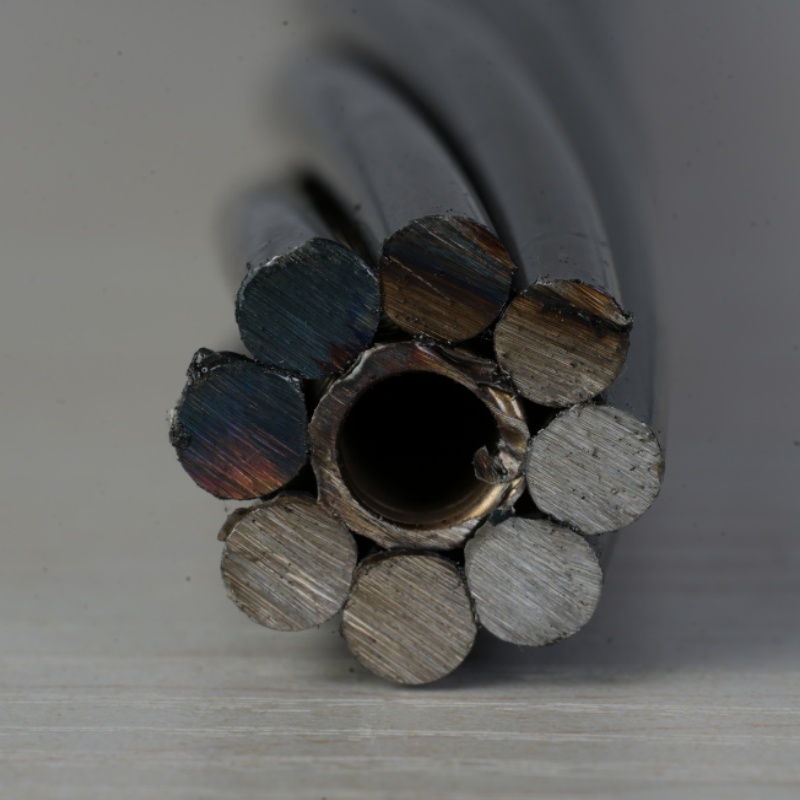
The unique ability to transfer fluids and house sensors makes this specialized steel an indispensable component in modern infrastructure. Its applications are heavily concentrated in sectors requiring rapid stabilization and long-term durability under extreme stress.
Underground mining operations face constant threats from strata collapse and seismic shifts. Traditional solid rock bolts often fail to provide immediate, full-column bonding in highly fractured rock masses. By deploying hollow strands, engineers achieve rapid roof stabilization. The strand is inserted into the rock ceiling, and fast-setting resin is pumped through the core. As the resin extrudes and hardens around the exterior, it locks the rock strata together. This creates a reinforced compression arch that drastically reduces cycle times in active mining headings.
In infrastructure projects involving deep excavations or unstable highway slopes, preventing soil shear failure is the primary objective. Hollow cables are driven deep into the embankment to serve as soil nails or tie-back anchors. Because the grout is delivered directly to the deepest point of the bore, it reliably forms a secure bond bulb in the stable soil zone. As the grout cures, active tensioning applies compressive force to the unstable soil wedge, effectively neutralizing landslide risks.
While unbonded strands dominate commercial slabs, hollow variants are reserved for specialized heavy civil structures like offshore oil platforms and segmental box-girder bridges. In these high-stakes environments, engineers require absolute certainty that post-tensioned tendons are fully encapsulated. The hollow bore allows for secondary vacuum grouting, ensuring that any microscopic voids left in the external ducting are filled from within the cable itself.
In recent years, the geotechnical engineering sector has witnessed a massive paradigm shift. As aging infrastructure demands more robust interventions, industry analysts note a growing reliance on multi-functional reinforcement systems. The integration of advanced sensor technology within these hollow channels represents a major leap toward predictive maintenance.
Rather than reacting to catastrophic structural failures, engineers now leverage the hollow bore to monitor micro-strain in real-time. This proactive approach extends the lifecycle of critical assets and significantly lowers long-term maintenance budgets. Furthermore, the global push for accelerated construction schedules has made simultaneous drilling and grouting an operational standard rather than a luxury. By combining drilling, flushing, and grouting into a single step, contractors are reducing labor costs and equipment downtime, cementing the hollow bore design as a cornerstone of modern civil engineering.
The mechanical integrity of a hollow cable relies entirely on the metallurgical quality of the steel. For infrastructure projects designed with a 50-to-100-year lifespan, standard commercial steel is simply insufficient. Procurement managers must specify materials that meet stringent international testing standards to guarantee long-term safety.
In metallurgical terms, relaxation refers to the gradual loss of tensile stress over time when a material is held at a constant length. If a steel cable is tensioned to 100 kips and locked into place, its internal crystalline structure will slowly yield over decades. This potentially drops the tension to dangerous levels, leading to catastrophic sagging in bridges or failure in ground anchors.
Utilizing a Certified Low-Relaxation Prestressing Steel Strand solves this critical issue. These premium strands undergo advanced thermo-mechanical stabilization during manufacturing. This permanently alters the steel dislocation density to ensure stress loss remains under 2.5 percent after 1,000 hours of constant load. With ultimate tensile strengths frequently reaching 1860 MPa, these materials deliver uncompromising stability.
Procuring uncertified steel introduces severe liability and structural risk. Certified strands are subjected to rigorous, independent laboratory testing to verify compliance with global standards such as ASTM A416 for the USA, EN 10138 for Europe, and ISO 6934. These standards dictate strict tolerances for ultimate tensile strength, yield strength, and fatigue resistance under cyclic loading. This allows structural engineers to calculate exact load capacities with absolute precision.
The integration of a central void introduces specific mechanical and operational efficiencies that directly benefit construction contractors and project owners. These advantages extend well beyond fluid transfer, impacting the overall lifecycle and installation speed of the anchor.
Traditional external grouting methods often trap air pockets within the borehole, creating blind spots where the steel is exposed to groundwater. Because hollow strands pump grout from the deepest point of the anchor outward, the rising column of dense grout naturally displaces lighter groundwater and trapped air. This mechanism guarantees full encapsulation of the steel, maximizing the friction interface between the anchor and the surrounding rock.
Handling heavy steel coils in confined underground spaces presents significant logistical challenges. The hollow center inherently reduces the linear weight of the cable per meter compared to a solid bar of the same outer diameter. Picture a two-man crew working in a damp, confined mine shaft. This improved strength-to-weight ratio drastically reduces worker fatigue, accelerates manual installation, and lowers transportation costs without sacrificing the ultimate breaking load.
Corrosion remains the primary cause of failure in geotechnical reinforcement. While standard cables rely solely on external sheathing, the hollow bore provides a secondary, internal defense mechanism. When filled with highly alkaline cementitious grout or inert epoxy resin, the bore creates an internal chemical shield. This prevents moisture ingress from the exposed ends of the cable, effectively halting internal oxidation in aggressive, high-chloride environments.
The successful deployment of a hollow cable requires precise execution by trained contractors. The installation process is highly systematic, ensuring that mechanical tension and chemical bonding work in perfect unison on the job site.
The process begins with borehole preparation. If the cable is used as a self-drilling anchor, a sacrificial bit is attached to the strand, and a rotary percussive drill rig drives the cable directly into the soil. During this active drilling phase, flushing fluids clear the hole. If pre-drilling is required, a standard casing is driven into the earth, the drill string is removed, and the hollow cable is manually inserted to the specified design depth.
Once the anchor achieves its initial set at the distal end, the cable must be stressed. Contractors slide a heavy-duty steel bearing plate and an anchoring wedge block over the exposed strand. A calibrated hydraulic stressing jack pulls the steel to a precise, pre-calculated tonnage. The wedges are then seated, mechanically locking the active compressive force into the rock face.
With the cable permanently tensioned, the final grouting phase commences. A specialized high-pressure grout adapter is securely threaded onto the exposed hollow end. A positive displacement pump forces the pre-mixed grout into the bore. The on-site engineer monitors the pump pressure continuously, looking for a steady flow rate. Grouting is only considered complete when pure, uncontaminated grout is visually observed returning to the surface at the collar of the borehole.
For procurement managers and lead engineers, selecting the correct material specification is a critical decision that impacts both project safety and budget. Evaluating suppliers requires a strict assessment of manufacturing capabilities and product tolerances.
The internal diameter of the central void is a critical specification that must be precisely matched to the rheology of the intended grout. If the project requires a thick, highly viscous cement, a larger bore diameter is necessary to prevent dangerous pressure spikes and pump blockages. Conversely, if the bore is only housing thin fiber optic cables, a smaller internal diameter is sufficient.
Buyers must consult with structural engineers to calculate the optimal balance between fluid flow rates and required tensile loads. For example, selecting a Hollow Prestressing Steel Strand for Mine Support with standard specifications like 15.24mm or 17.8mm outer diameters ensures compatibility with standard mining resin cartridges and high-pressure grout pumps.
A reliable supplier should operate a fully integrated manufacturing facility capable of producing a diverse portfolio of prestressing materials. Procurement teams must request comprehensive Mill Test Reports providing traceable data on chemical composition, yield strength, and relaxation rates for every single batch. Premium manufacturers will also offer customizable solutions, including specific cut lengths and a complete suite of compatible accessories like drill bits and anchor plates.
Heavy steel products are highly susceptible to mechanical damage during transit. Hollow cables should be wound into large-diameter, tension-free coils to prevent the central tube from kinking. The coils must be tightly bound, wrapped in vapor-corrosion-inhibitor materials, and securely palletized to block moisture ingress during maritime shipping. Reliable on-site handling guidelines are just as important as the metallurgical quality of the steel itself.
What runs through the hollow bore truly matters. It transforms a simple structural cable into a multi-functional engineering system. Whether high-strength grout, protective epoxy resin, or advanced fiber optics fill this void, these elements work together to ensure your structure remains completely safe and stable for decades. However, the success of the entire system depends entirely on the metallurgical quality of the steel enclosing that void. Always source certified, low-relaxation materials for your engineering projects. We strongly recommend visiting TJ Dejia to explore a comprehensive range of premium prestressing materials tailored to your exact geotechnical needs.
Yes. In complex civil engineering structures, such as segmental bridges or large-scale parking garages, it is highly common to use multiple types of prestressing tendons. Unbonded PC strands are typically utilized for standard longitudinal post-tensioning within the concrete slabs. Meanwhile, hollow strands are deployed in specific, high-stress areas that require active ground anchoring, rock stabilization, or internal grouting for permanent corrosion resistance. The two systems complement each other perfectly within a comprehensive structural design.
The internal dimensions vary based on the overall diameter of the cable and the specific engineering application. However, standard industry inner diameters generally range from 7mm to 15mm. The overall outer diameter of the strand usually dictates the maximum possible bore size. Engineers must calculate the required flow rate of the grout or the physical dimensions of the monitoring sensors to select the most appropriate dimensions for their project.
No, it is not always mandatory. While pumping cementitious grout or resin is the most common application for ground anchoring and mining support, the bore serves multiple purposes. In modern infrastructure projects, the bore is sometimes left entirely open to house delicate fiber optic sensors for continuous structural health monitoring. In other scenarios, it is used only temporarily to flush water or compressed air during the active drilling phase of a self-drilling anchor system.
The strand is specifically engineered to compensate for the absence of a solid core wire. Manufacturers achieve this by utilizing higher-grade, high-carbon steel for the outer helical wires and optimizing the stranding geometry. When manufactured correctly and tested to rigorous low-relaxation standards, a hollow strand meets or exceeds the strict load-bearing requirements necessary for heavy civil engineering. It provides the required ultimate tensile strength while offering the added functional benefits of a central delivery channel.
Hollow strands drastically improve efficiency by utilizing an inside-out grouting method. Instead of pumping grout through an external tube alongside a solid bar, the grout travels directly down the center of the hollow strand and fills the borehole from the deepest point upward. This natural upward flow displaces trapped air and groundwater, eliminating voids and ensuring a much faster, cleaner, and more reliable bond between the steel and the surrounding rock.
The maximum pumping pressure depends heavily on the internal diameter of the strand and the viscosity of the grout mix. Generally, standard geotechnical grout pumps operate between 5 to 15 MPa. High-quality hollow strands are engineered with continuous, seamless internal steel tubes designed to withstand these high-pressure injections without rupturing or leaking, ensuring smooth fluid delivery even in deep subterranean boreholes.


