
Views: 0 Author: Site Editor Publish Time: 2026-10-26 Origin: Site


Unseen corrosion causes the vast majority of concrete structural failures. Moisture ruthlessly destroys tensioning materials without proper protective barriers. In this comprehensive guide, we strip away the theory. You will learn the exact methodologies industry professionals use to verify grease fill on an unbonded system. This ensures your project achieves long-term structural integrity and avoids catastrophic degradation.
Crucial Protection: The grease fill acts as a specialized corrosion-inhibiting coating. It serves as the primary defense against moisture ingress and internal friction.
Strict Standards: Quality control protocols must align tightly with Post-Tensioning Institute and ASTM specifications. These mandate a specific minimum weight per linear meter to guarantee performance.
Rigorous Testing: Volume and consistency are empirically verified. We use factory mass calculations, visual field audits, and advanced void-detection technologies.
Material Selection: Procurement strategies must prioritize reputable manufacturers. Always demand documented factory testing and batch-specific encapsulation reports before signing off on a delivery.
In modern post-tensioned concrete construction, an unbonded strand operates as a specialized high-strength steel cable. It is engineered to move independently of the surrounding concrete slab. Traditional rebar or bonded systems adhere directly to the cured cement paste. In contrast, this tendon is completely encased in a continuous, extruded high-density polyethylene plastic sheath.
The microscopic space between the bare steel wire and the inner wall of the plastic sheathing is packed tight. We use a specialized, corrosion-inhibiting organic lubricant. This unseen layer performs two non-negotiable structural functions.
First, it provides absolute corrosion prevention. Concrete is inherently porous. When water, de-icing salts, or oxygen inevitably penetrate the matrix, the grease acts as a hydrophobic barrier. It completely encapsulates the steel. This halts oxidation and pitting that would otherwise compromise the load-bearing capacity.
Second, the lubricant ensures friction reduction. During the hydraulic tensioning process, the steel cable must elongate freely within its plastic casing. Excessive friction prevents the applied force from distributing evenly across the slab. This triggers immediate structural deficiencies.
Consequently, without continuous coverage, a Post-Tensioned Strand remains highly vulnerable to environmental degradation. Even a microscopic void can trap condensation. This creates a localized micro-environment where aggressive corrosion accelerates rapidly. Replacing a ruptured tendon costs exponentially more than sourcing quality materials upfront.
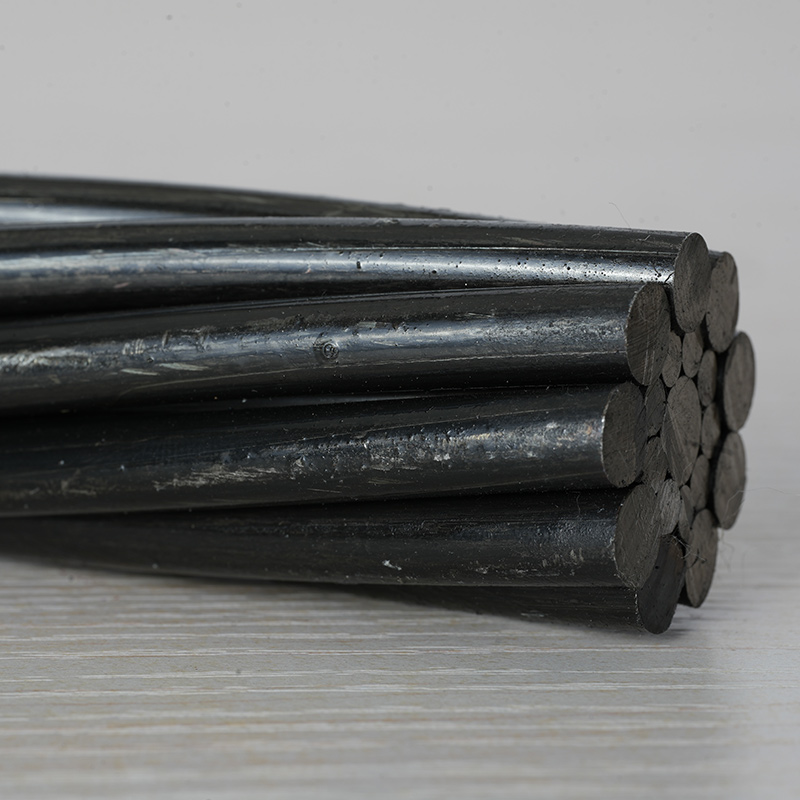
The structural integrity of parking garages, high-rise slabs, and bridges relies heavily on standardized manufacturing practices. Global construction authorities, including ASTM and the Post-Tensioning Institute, established strict empirical guidelines for applying these corrosion inhibitors.
Adhering to standards such as ASTM A416 ensures the base steel meets rigorous tensile strength requirements. Specifically, a standard grade often requires a minimum tensile strength of 1860 MPa. However, system specifications go much further. They dictate the exact physical and chemical properties of the entire unbonded assembly.
Regulatory bodies mandate that the annular space must be completely filled. This is the void between the outer perimeter of the seven-wire steel cable and the inner diameter of the polymer sheath. Standards dictate a specific minimum weight of grease per unit length, usually measured in grams per linear meter. This required mass fluctuates depending on the nominal diameter of the Prestressing Steel Strand deployed on the job site.
Furthermore, the construction sector is currently witnessing a significant paradigm shift. Recent infrastructure audits across aging urban centers have revealed hidden tendon corrosion as a critical failure point. As a result, engineering firms are no longer accepting baseline visual compliance. There is a massive industry trend demanding real-time factory data and automated quality control logs. Manufacturers are being pushed to adopt smart extrusion lines equipped with laser scanning. This guarantees zero-defect encapsulation before the product ever reaches the shipping yard.
Verifying the fill is an empirical process. It occurs in two distinct phases: factory-level laboratory testing and on-site field inspections. Both play a pivotal role in ensuring the material performs exactly as engineered.
The most accurate method for determining volume is the mass calculation test. Technicians perform this destructive testing method in the manufacturer's quality control laboratory. It provides quantifiable data to prove compliance.
Using a heavy-duty abrasive saw, a technician cuts a precise 1.0-meter length of the fully assembled strand directly from the production line. They weigh the entire sample on a highly calibrated digital scale to determine the total mass.
Next, the technician carefully slices open the sheathing and extracts the steel cable. They scrub the steel wire and the inside of the plastic jacket using chemical solvents. This removes every trace of the corrosion-inhibiting compound. Once completely dry, they weigh the bare steel wire and the empty plastic sheathing separately.
We calculate the mass of the grease using a simple formula. We subtract the bare steel and sheathing mass from the total mass. This final figure is cross-referenced with the minimum volume requirements specified by the project engineer.
Site inspectors do not carry precision laboratory scales in their trucks. However, they must still verify material condition upon delivery and during installation.
When I walk a deck before a concrete pour, a simple but effective technique is the squeeze test. Applying firm thumb pressure to the jacket under the hot afternoon sun should meet with solid resistance. If the sheath yields softly, compresses easily, or emits a faint crinkling sound, alarm bells should ring. An air void is lurking beneath.
In addition, at the anchorage points, workers strip back the sheath to allow the wedges to grip the bare steel. During this process, inspectors visually confirm that the newly exposed steel is heavily coated in a uniform layer of grease. It must be entirely devoid of dry spots or flash rust.
When procurement teams fail to specify rigorous quality control, the consequences of inadequate grease fill are severe and often irreversible.
Friction Loss During Tensioning: The fundamental principle of post-tensioning relies on applying hydraulic force to the ends of the cable. The cable then stretches and applies compressive force to the concrete. If dry spots exist where the steel rubs directly against the inner plastic sheath, the coefficient of friction spikes dramatically. The required tensioning force fails to reach the center of the slab. The concrete will not achieve its designed compressive strength. This paves the way for excessive deflection and cracking.
Pitting, Corrosion, and Embrittlement: An unbonded system relies entirely on its internal coating for environmental defense. Empty pockets inside the sheath act as moisture traps. Due to ambient temperature fluctuations, condensation forms inside these microscopic voids. When high-carbon steel is exposed to trapped water and oxygen, localized pitting corrosion begins rapidly. In severe cases, this aggressive micro-environment leads to hydrogen embrittlement. The steel becomes brittle and snaps under high tension.
System Type | Corrosion Protection Method | Quality Control Location | Primary Inspection Focus |
|---|---|---|---|
Bonded System | Cementitious grout pumped after tensioning | On-site during construction | Ensuring smooth grout flow and venting air pockets in ducts |
Unbonded System | Factory-applied organic grease and polymer sheath | Manufacturing facility | Verifying grease mass per meter and seamless plastic extrusion |
Understanding this distinction is vital. In a bonded system, quality control happens entirely on the construction site. In stark contrast, an unbonded system arrives pre-greased and pre-sheathed. Adding grease to the middle of the cable on-site is physically impossible. The structural integrity is permanently locked in the moment the product leaves the manufacturing facility.
The true integrity of the tendon is established long before it arrives at the construction site. Top-tier manufacturers utilize highly controlled, automated environments to ensure complete encapsulation.
Before any coating is applied, the bare high-carbon steel wires must be meticulously cleaned. The steel must be entirely free from residual drawing lubricants, surface rust, and particulate debris. If the surface remains contaminated, the corrosion inhibitor will fail to bond properly with the metal.
The most critical step occurs in the application chamber. The bare strand is continuously fed through a pressurized bath of specialized organic lubricating compound. Standard atmospheric dipping is insufficient. Manufacturers must use high-pressure applicators to force the substance deep into the interstitial spaces between the central king wire and the outer wires.
Immediately after exiting the pressurized chamber, the heavily coated strand passes through an extrusion die. Molten high-density polyethylene is hot-extruded directly over the moving steel. Temperature control during this phase is paramount. The polymer must be hot enough to form a seamless sheath, but carefully calibrated so the heat does not degrade the underlying lubricant.
Purchasing tensioning materials is an exercise in strict risk management. Sourcing reliable materials requires a systematic evaluation of the manufacturer’s internal quality control protocols and actual product specifications.
First, demand comprehensive Mill Test Certificates for every batch of steel. Buyers must explicitly request Encapsulation Test Reports. These documents provide empirical data proving that laboratory technicians have physically stripped the sheath from random samples. They confirm the mass meets strict industry standards. Sourcing a Certified Low-Relaxation Prestressing Steel Strand ensures the factory-applied coating meets stringent volume requirements and delivers a guaranteed 1860 MPa tensile strength.
Second, verify adherence to international material specifications. A high-quality unbonded strand is a composite material. The core wire must comply with standards such as ASTM A416 or BS5896. The coating must be completely free of water-soluble chlorides, sulfides, and nitrates. For specialized underground applications, engineers specify variations like the Hollow Prestressing Steel Strand for Mine Support. This demands equally rigorous encapsulation standards tailored to harsh subterranean environments.
Finally, evaluate logistics and handling protocols. Unbonded tendons are highly susceptible to mechanical damage during transit. Premium suppliers utilize reinforced wooden reels, heavy-duty strapping, and protective outer wrappings. This ensures the product arrives at the job site entirely intact.
Checking the grease fill is an indispensable practice. It ensures the safety and longevity of post-tensioned concrete structures. Proper testing and verification prevent severe internal corrosion and catastrophic structural failures over time. To mitigate risks, always partner with a trusted manufacturer that implements rigorous factory-level testing and automated monitoring.
Are you looking for reliable tensioning materials that guarantee exact volume metrics and proper polymer encapsulation? Choose a manufacturer that understands the critical nature of unseen protection. Visit tjdejia.com today. Contact our engineering sales team for detailed technical data sheets, request quality control reports, and secure a quote on premium tensioning materials tailored to your next major project.
The substance used inside an unbonded strand is not standard mechanical grease. It is a highly specialized, corrosion-inhibiting organic lubricating compound. This grease is engineered specifically for civil construction applications. Chemically, it must be entirely inert. This means it will not react with the high-carbon steel core or degrade the surrounding polymer sheath over decades of exposure. It must possess a high dropping point to ensure it does not liquefy and bleed out during extreme summer temperatures.
As a general rule, the primary length of an unbonded strand cannot be re-greased or manually filled on the construction site. The strand relies on the factory extrusion process. Here, the polymer sheath is hot-extruded tightly over the pressurized grease bath, ensuring continuous encapsulation. However, field greasing is mandatory at the anchorages. After tensioning and cutting, the exposed steel ends must be manually packed with approved corrosion-inhibiting grease and sealed tightly with specialized encapsulation caps.
The exact volume of grease required is strictly governed by industry standards. The requirement is typically measured by mass per unit length. For a standard 12.7 mm strand, industry guidelines generally require a minimum grease weight of approximately 50 to 60 grams per linear meter. For a larger 15.24 mm strand, the minimum required mass increases to accommodate the larger surface area and greater interstitial volume. This often requires upwards of 75 grams per meter.
This is a highly engineered tensioning cable that has undergone a specific thermomechanical treatment during its manufacturing process. The steel strand is subjected to a process called stabilization. It is simultaneously stretched and heated to roughly 400 degrees Celsius. This permanently alters the metallurgical grain structure. It significantly reduces its tendency to lose tension over decades of sustained load.
Detecting voids in an already poured concrete slab requires advanced non-destructive testing methods. Engineers typically utilize ground-penetrating radar to locate the exact position of the tendons within the slab. Once located, specialized ultrasonic impact echo testing or magnetic flux leakage tools can scan the length of the embedded cable. These tools identify anomalies in density or loss of metallic cross-section, which indicate severe voids and active corrosion.
When manufactured with strict quality control and installed without damaging the polymer sheath, an unbonded system is designed to match or exceed the lifespan of the concrete structure itself. Modern building codes typically engineer these structural components for a 50-year to 100-year design life. The inert nature of the specialized organic grease ensures it will not break down, providing continuous hydrophobic protection for decades.


